Speak to a friendly advisor about your options: 01733 838245

BSc (Hons) Animal Management and Welfare (Top-Up)
- Course Type: Undergraduate Degree
- Institution Code: P56
What can this course lead to?
Graduates in Animal Management and Welfare at this level will typically acquire employment in managerial or supervisory roles within the industry e.g. section heads and education officers in:
- Zoos
- Senior Animal Technicians in research facilities
- Kennel/Shelter/Farm Managers
- Conservation Officers
- Veterinary Technician
- Research Assistants
- Animal Management Tutors/Lecturers.
Who is it for?
This course is aimed at students who want to be part of an adaptive, responsive, conscientious and welfare-focused workforce to deal with the many challenges and opportunities the animal management sector may face in the future.
The course encourages students to develop their analytical and critical evaluation skills through the assessment of animal welfare, the application of behaviour modification strategies, and the evaluation of captive husbandry to enhance animal management practices and promote animal health, welfare and conservation outcomes.
The course also focuses on the ethics of animal management and discusses mitigation strategies for growing human-animal conflict issues to encourage sustainable coexistence. You will learn about appropriate research methodologies and data analysis in preparation for your dissertation, in which you will undertake an independent research project to investigate a specific research question or hypothesis. On the course, you will have a unique opportunity to enhance your practical animal management skills and contextualise your learning by working behind the scenes with a range of rare and endangered species at Whipsnade Zoo (part of the Zoological Society of London).
You will undertake a series of visits throughout the year to learn about exotic animal management and its challenges, and get hands-on with enrichment building, accommodation maintenance, feeding, handling and undertaking essential research.
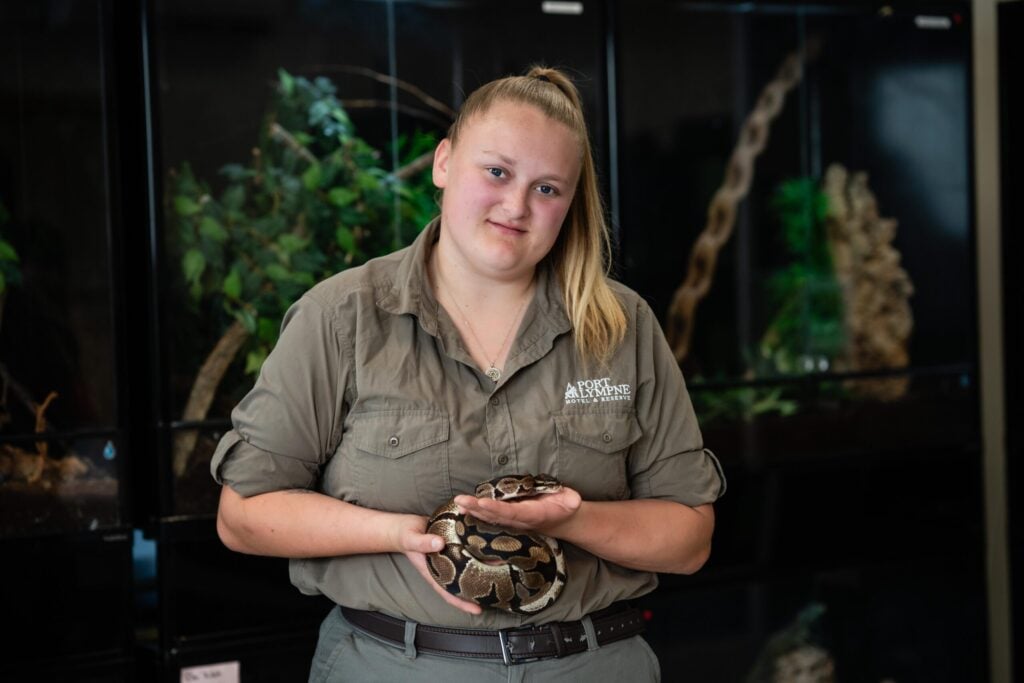
You will also have the opportunity to study in the on-site Animal Management Centre, which is home to over a hundred species of exotic and domestic animals, ranging from hamsters, rats and budgies to tenrecs, meerkats and pythons.
To view the course specification, click here.
You can view The Open University regulations here.
What is covered?
Year one for full-time students (Level 6)
- Animal Welfare and Ethics - (15 credits)
- Applied Animal Behaviour - (15 credits)
- Wild Animals in Captivity - (15 credits)
- Research Methods and Data Analysis - (15 credits)
- Applied Animal Health - (15 credits)
- Human-Animal Coexistence - (15 credits)
- Dissertation - (30 credits)
Frequently Asked Questions (FAQs)
A Level 5 qualification (240 credits) in an animal-related subject such as a Foundation Degree or Higher National Diploma at Merit grade or above and GCSE grades 4/C in English Language and Maths. Applicants will also need a suitable academic reference.
When studying this course, we will timetable your lectures into one of two full days a week over two semesters per year (see Duration and delivery for exact details). We are able to offer this convenient timetabling to our students as we are a smaller institution so we can timetable our staff and resources more efficiently.
There are two semesters per year and each semester is up to 15 weeks which includes up to 12 teaching weeks and 3 assessment weeks.
If studying full-time you will be in classes, seminars and tutorials for approximately 15 hours per week and will spend the rest of your time in independent study and extra-curricular activities including work placement if not embedded in your course. We recommend that full-time students allow an additional 30 hours per week for additional study.
Assessments at level 6 allow students to showcase their evaluative and analytical problem-solving skills throughout the programme. Assessments are delivered through scenario or ‘life brief’ methods to enable students to apply cognitive understanding and practical skills to vocational contexts. A wide variety of assessment strategies are employed, appropriate to the specific learning outcomes which are being assessed.
Modes of assessment include essays, practical performance, scientific report, research projects, case studies, portfolios, academic posters, presentations, discussions/debates, open-book exams and data-analysis.
Visit our published documents and policies page for The Open University regulations.
There may be additional costs for this course which are not covered by the tuition fee.
The level 6 top up offers students a unique employer engagement opportunity to work with industry professionals at the globally recognised Zoological Society of London (ZSL) at Whipsnade. Here students will embark on a series of practical activities and workshops to contextualise theoretical aspects covered in the course modules and provide opportunities for work-based learning. The programme of activities includes animal enrichment design, zoo nutrition and feeding, exotic animal health, animal training and enclosure design.
Students will also have the opportunity to learn vital transferable industry skills in the on-site animal facility which houses a number of exotic, domestic and companion animals. Students have the opportunity to learn about and assess the animal husbandry provision of these species in line with current animal welfare regulations. The facility also offers the perfect venue for independent research for assessments and as a resource for their investigations as part of their dissertation.
As the course is timetabled as full days during the week when studied full-time, this also gives you the flexibility to find a work placement, internship or volunteering opportunity which will improve your employability after you graduate. The University Centre has strong links with local vets, boarding facilities, shelters and zoos/wildlife parks.
John-Paul Oldham
“I am the Course Leader for the BSc Animal Management and Welfare (top Up) at the University Centre Peterborough (Stamford Campus).
I have been lecturing on animal management programmes at the Stamford College campus since 2008 where I have been instrumental in the curriculum design and provision. Before this I taught at Nottingham Trent University as an Animal Science Lecturer teaching undergraduate zoo biology and animal biology students.
Before embarking on a career in teaching I worked as a Laboratory Manager and HACCP (Hygiene Analysis and Critical Control Points) Coordinator at a leading pet food manufacturer, analysing pet food ingredients to meet quality standards for leading brands such as Nestle, Hills and Mars Pet Care. I have also worked in a number of areas of the animal industry including boarding kennels, pet shops, aquatics centres, livery yards and as a wildlife watch leader for Notts Wildlife Trust.
I recently completed my MSc in Endangered Species Recovery and Conservation at Nottingham Trent Universities School of Animal Rural and Environmental Sciences. My thesis investigated possible mitigation strategies for human-wildlife conflict in the Limpopo province of South Africa, assessing the impact of carnivore predation on livestock and strategies to promote coexistence.
I graduated from Nottingham Trent University with a BSc (Hons) in Animal Science, where, for my dissertation, I studied the impact of perching enrichment on chickens to improve flock welfare and encourage the implementation of perches into modern commercial systems. Prior to this I studied the BTEC National Diploma in Animal Care at Brackenhurst College.
My key research interests are in conservation and species recovery, ecology, anthrozoology, animal behaviour and welfare.
I look forward to working with you all on the HE Animal Management course at the Stamford Campus.”
Qualifications
- MSc Endangered Species Recovery and Conservation
- BSc (Hons) Animal Science
- BTEC National Diploma in Animal Care
- PGCE (Post Graduate Certificate in Education) in Post Compulsory Education
Course information
Ucas Code
D302
Location
Stamford
Start Date
September
Fees
The tuition fees for full-time undergraduate students will be £9,000 per year, which is lower compared with many other universities.
Fees for part-time study are pro-rata depending on the number of credits you are studying (i.e. 90 credits per year will be 75% of the tuition fee).
Duration
Full-time: 1 year (2 full days a week over two semesters per year)
Part-time: 2 years (1-2 full days a week over two semesters per year)
Validated by
The Open University
Incredible courses in partnership with The Open University
Validated Excellence
Our partnership with The Open University ensures that a significant number of our foundation diplomas and undergraduate degrees are validated by one of the UK’s most respected institutions, enhancing the credibility and recognition of your qualification.
Quality Assurance
Each course validated by The Open University undergoes rigorous quality assurance checks, guaranteeing that our curriculum meets high academic standards and delivers an exceptional educational experience.
Flexible Pathways
Through our collaboration with The Open University, students at University Centre Peterborough benefit from flexible learning options and expertly designed courses that support both part-time and full-time studies, tailored to accommodate diverse student needs.
Company Logo
 enquiries@ucp.ac.uk
01733 214466
enquiries@ucp.ac.uk
01733 214466
University Centre Peterborough
Park Crescent, Peterborough, Cambridgeshire, PE1 4DZ
Part of the Inspire Education Group © 2025 All rights reserved
Website by Itineris